Achievement unlocked: Hemorrhoidectomy
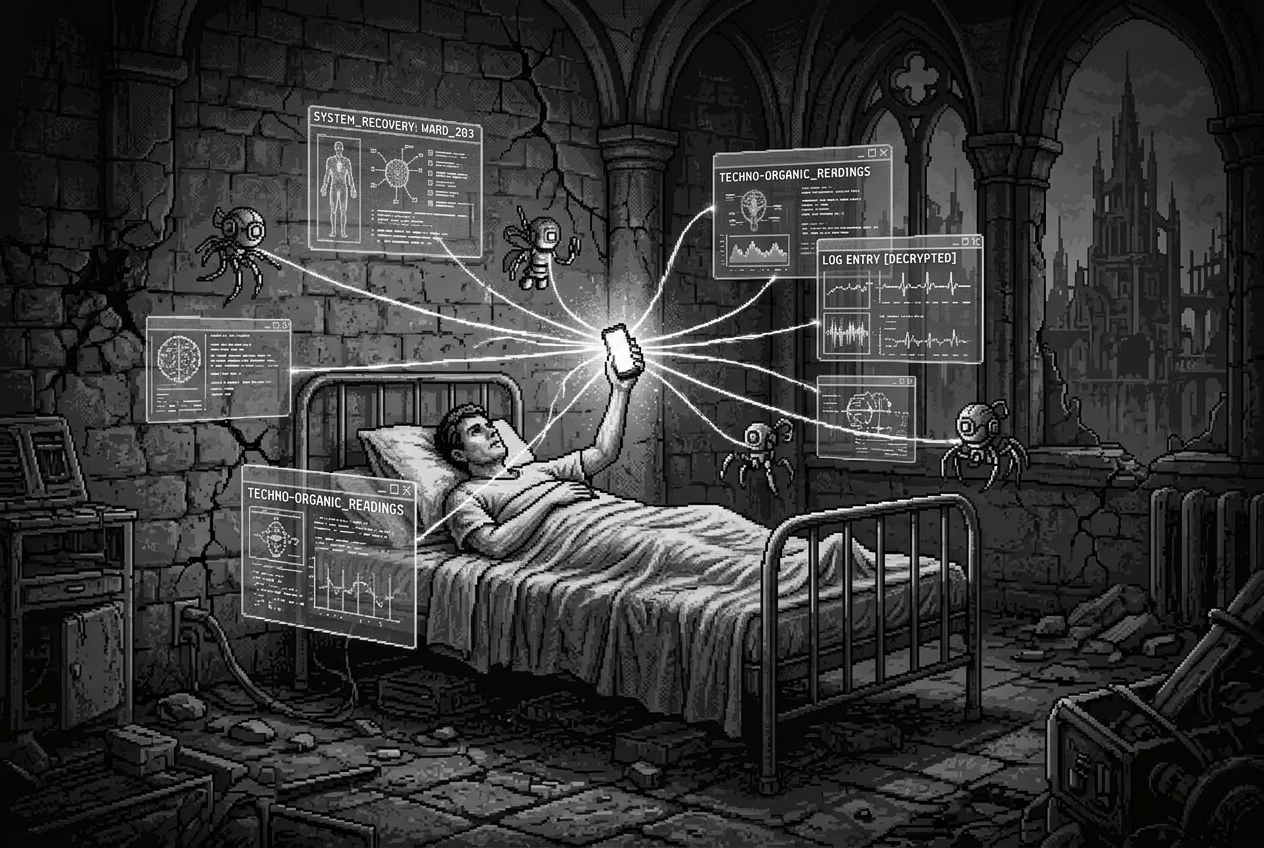
I spent several weeks recovering from surgery in a position I do not recommend: mostly horizontal, moving carefully, and measuring every trip across the room against the pain it would cost.
It gave me an odd experiment.
I could not sit at a desk properly. I could not move around freely. A lot of normal work habits became stupid overnight. So I started doing almost everything through my phone, by talking to an AI agent.
At first it was coping. Then it became a workflow.
If I needed to understand something, I talked it through. If I needed code written, I described the outcome. If I needed a document, a report, a script, a reminder, a summary, or a second brain that did not mind me being foggy from pain medication, I used the machine in my pocket.
The results surprised me.
During recovery, I built a small pile of applications and command-line tools. I pushed tens of thousands of lines of code. I developed a digital twin from years of text and voice artifacts. I used AI to track symptoms, medication schedules, and recovery milestones. It helped produce reports for my doctors that were clearer than anything I could have written on my own while drugged, tired, and annoyed at my own body.
It even helped me with taxes, which feels less like a technological miracle and more like proof that God has a sense of humor.
I am not saying any of this because the numbers matter. The numbers are the least interesting part. I am saying it because the constraint made the change obvious.
When you can accomplish serious work while you cannot sit up properly, something has shifted.
Most public conversations about AI get stuck in the same loops. AI will take jobs. AI will flood the world with garbage. AI will replace artists. AI will make every computer cost a billion dollars so we can generate dancing cat videos with extra fingers.
Some of that criticism is fair. Some of it is already true. This technology can be ugly. It can deskill people. It can flatten taste. It can generate confident nonsense at industrial scale.
It can also give capability back to someone who temporarily lost access to their normal body.
That second part deserves more attention.
The most interesting version of AI is not the one where a company replaces a person with a cheaper autocomplete box. The interesting version is the one where a person becomes more capable than their circumstances should allow.
A recovering patient coordinates care better.
A distracted executive turns fuzzy intent into working software.
A friend dealing with cognitive challenges gets help remembering, sequencing, and navigating daily life.
A tired person who cannot face a blank page starts with a conversation instead.
This is where my own position has changed. I used to carry more hesitation. I still think the risks are real. I still think judgment matters more than ever. I still think people can use these tools to avoid thinking, and that is dangerous.
But I no longer believe serious professionals can treat AI as optional background noise.
Use the basic tools. Use ChatGPT, Claude, Gemini, Copilot, whatever your environment allows. Use them to read, compare, summarize, draft, test, code, challenge, and explain. If you write software, learn the coding assistants. If you manage people, learn how to turn vague intent into a concrete plan without outsourcing accountability. If you handle sensitive information, learn the security boundaries instead of pretending avoidance is a strategy.
You do not need to become an AI influencer. Please do not become an AI influencer.
You do need to build taste. You need to know when the answer is plausible but wrong. You need to know what should never leave your environment. You need to know when the machine helped and when it merely produced something that sounds finished.
Do not outsource your thinking.
You are still the talent. Your judgment, context, taste, ethics, and courage remain the scarce part. The AI helps you move faster, see more options, and recover some lost leverage. It does not absolve you from owning the result.
That is the deal.
After this recovery, I find myself much less patient with AI hesitation from people whose work depends on knowledge, writing, coordination, analysis, or software. The tools are here. They are already good enough to matter. They will get better. The fart is not going back in the ass.
So learn them.
Not because the hype people are right about everything.
Learn them because one day you may find yourself constrained, overloaded, injured, responsible for too many things, or simply stuck. When that day comes, the difference between “I have a chatbot account somewhere” and “I know how to work through this system” will matter.
I learned that lesson from a recovery bed.
Achievement unlocked, I guess.